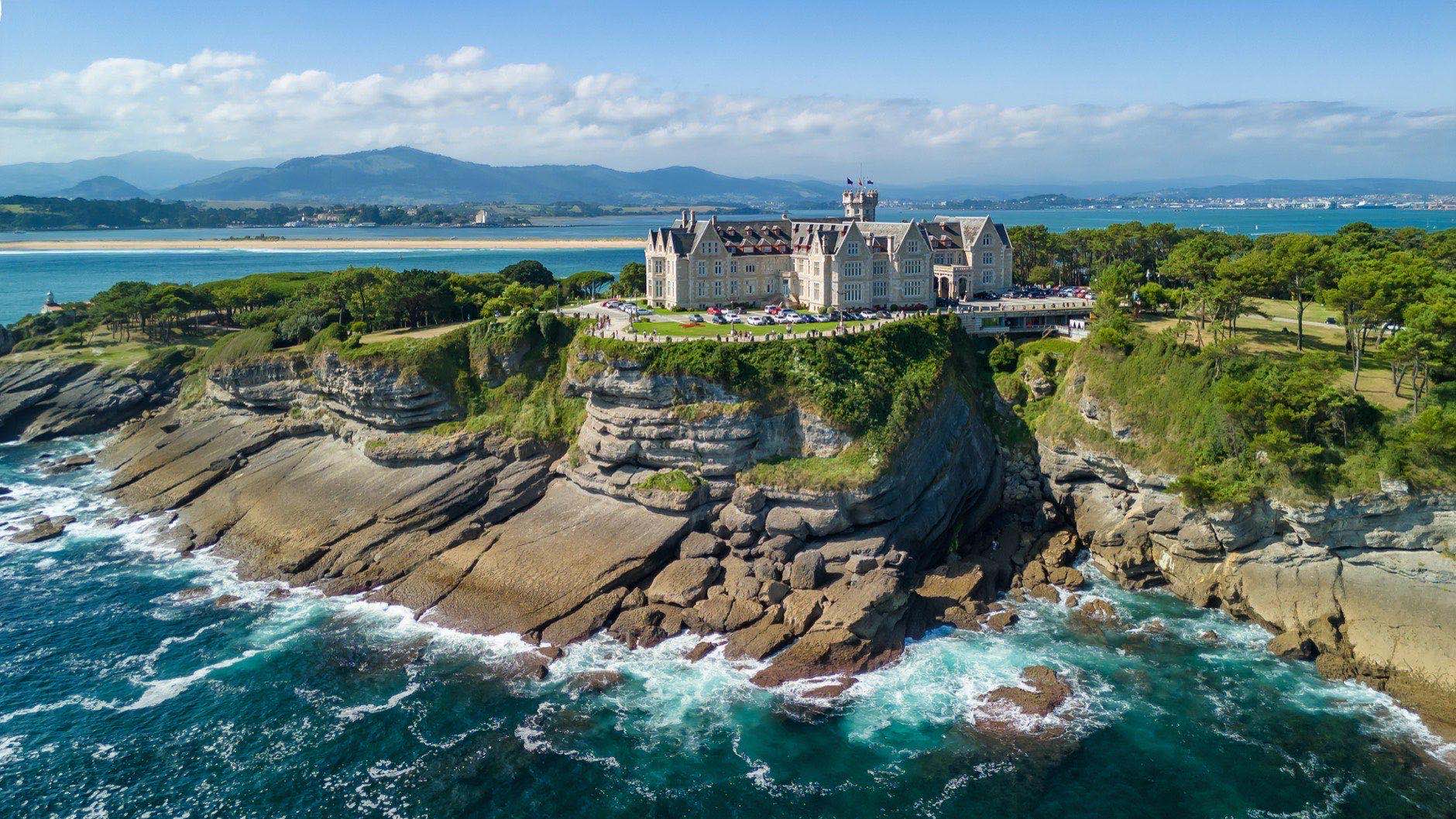
Santander
Santander is the capital of Cantabria in northern Spain, with around a hundred and seventy thousand residents. The city sits on a long bay open to the north and grew up around its port. In nineteen forty-one a fire driven by a southerly wind burned out almost the whole centre, so there is little old building here, and what survives stands around the edges.
Santander was a summer capital: in the early twentieth century the royal court came for the season, and the Magdalena palace on the headland remains from those days. Today it is an ordinary northern city with a university, hospitals and a ferry to Britain. The climate is Atlantic. Rain in every month, a winter without frost, a cool summer, a cold sea. Housing costs less than in the Basque Country and more than in Galicia. Anyone coming for warm water should not come north — and that is worth understanding at once.
- Comillas · 50 km — the Gaudí house and the coast to the west
- Bilbao · 100 km — the Guggenheim and a bigger airport
- Santillana del Mar · 30 km — the medieval town and the Altamira cave nearby
Santander sits in Cantabria, right on the water. You can live here without a car: our rating is 5 out of 5, rare on the Spanish coast, and the town has its own train station. Winters are damp at 78% humidity, so ask about mould before you sign. The airport is 10 minutes away, closer than for most places in the database.
Hospital, terrain, getting around
Where from: the Ministry of Health hospital catalogue, road time · elevations from the Copernicus terrain model · OpenStreetMap · ratings for car-free and hospital minutes are ours.
Santander sea temperature by month
3 months above 20 °CsourceAverage sea surface temperature, °C, for 2015–2024 — NOAA OISST satellite series, grid cell 18.8 km from the centre.
Tourist load
Santander beaches and water quality
sourceSantander has 6 beaches tested under EU bathing water rules, at 6 sampling points. In the 2025 season, all 6 were graded excellent. No beach here has been graded “poor” since testing began in 1990.
The grade is bacteria in water samples over the last four seasons — not sand, views or crowds. “Poor” means bathing there is advised against.
| Beach | From the centre | Grade 2025 | “Excellent” in a row | Last “poor” |
|---|---|---|---|---|
| Playa 2 Sardinero | 2.6 km | excellent | 13 seasons | none since 1990 |
| Playa 1 Sardinero | 2.6 km | excellent | 14 seasons | none since 1990 |
| Playa de la Magdalena/Peligros | 2.6 km | excellent | 10 seasons | none since 1990 |
| Playa Camello | 2.9 km | excellent | 14 seasons | none since 1990 |
| Playa Matalenas | 3.3 km | excellent | 17 seasons | none since 1990 |
| Playa Virgen del Mar | 5.6 km | excellent | 12 seasons | none since 1990 |
Where from: European Environment Agency, bathing water register, seasons 1990–2025, licence CC BY 4.0. Distance is from the centre in a straight line. Every place in one table
On the map
What tenants actually pay
sourcedThis is the median rent on active leases — tax records for 2024, a sample of 12 703 leases. It includes long-standing contracts at unchanged rents, so it sits below what is asked today: our estimate of asking rent is 1 000 € for a two-bedroom.
The point of the 75th percentile: it is closer to what is being signed now than the median. The gap between them shows how much a new tenant overpays relative to long-standing ones.
Where from: SERPAVI, Ministerio de Vivienda · municipality: Santander
Rent by number of bedrooms
asking price, estimate| 1 bedroom | 750 €/mo | |
| 2 bedrooms | 1 000 €/mo | |
| 3 bedrooms | ≈ 1 300 €/mo | model: two-bed × 1.3, no measurement yet |
| Median of active leases, 2024 | 595 €/mo | SERPAVI · 72 m² |
Asking prices are what long lets are advertised at today; the registry is what tenants pay on signed leases, including old ones. The gap between them is your negotiating argument.
Schools nearby
estimateInternational schools counted in the base: 2. Names and curricula for this place are not verified yet — the school registry covers the thirty most-requested places so far.
Renting without a Spanish contract
How realistic a long lease is without a nómina — on foreign income, savings or prepayment.
- —Prices rising 9% a year — the landlord picks, and the first filter is a nómina
This is our model, not a measurement: demanding a nómina is an individual landlord's practice and nobody publishes it. The rating is derived from the share of foreign residents, the presence of a community with services, price growth, seasonality of the stock and the size of the town.
Who lives here
INE 2025- Peru3 467
- Colombia3 215
- Romania1 779
- Moldova1 328
- Venezuela955
- Ukraine840
- Italy596
- Paraguay585
- enEnglish~500
- deGerman~300
Where from: INE, Censo Anual de Población · the register-based census counts padrón registrations by citizenship on 1 January, not everyone living here: seasonal owners and the unregistered are outside it, and naturalised residents count as Spanish.
Winter direct flights from SDR
January 2026/2710 min to the airport- United Kingdom2
- other countries2
- Ireland1
- Belgium1
- France1
- Italy1
Destinations served at least weekly in January; checked 2026-09-17.
Paperwork and practicalities
From OpenStreetMap — an open map filled in by volunteers. Something missing there may still exist: read this as «we found this many», not «there are no more».
Month by month
Air, sea, how busy it gets and what stays open — for each month on its own.
Articles that include this place
- Moving from the UK: four differences nobody writes aboutNot the paperwork but daily life: a house with no heating, a winter both sunny and cold, a compulsory car, and a community that stops you learning the language.
- The coast without a carA resort stretched along a highway and an old port with a dense centre are different ways of living. Size is not what separates them.
- Retiring to coastal Spain: who already lives there, how far the hospital is, and whether the town stays open in winterThe share of residents over 65 and over 80 in every place we cover, from the INE census, the drive to the nearest public hospital, and the measured winter score. No ranking: only what the numbers show.
- Best places to live in coastal Spain: five lists, not one rankingAlive in winter, longer swimming, no car needed, cheaper, with children — five sorts of the base by measured fields. A single ranking does not exist.
Where to look next
- Laredo2 908 €/m²
- Castro Urdiales2 812 €/m²
- Punta Umbría2 226 €/m²
- Chiclana de la Frontera2 219 €/m²
- Oviedo2 206 €/m²