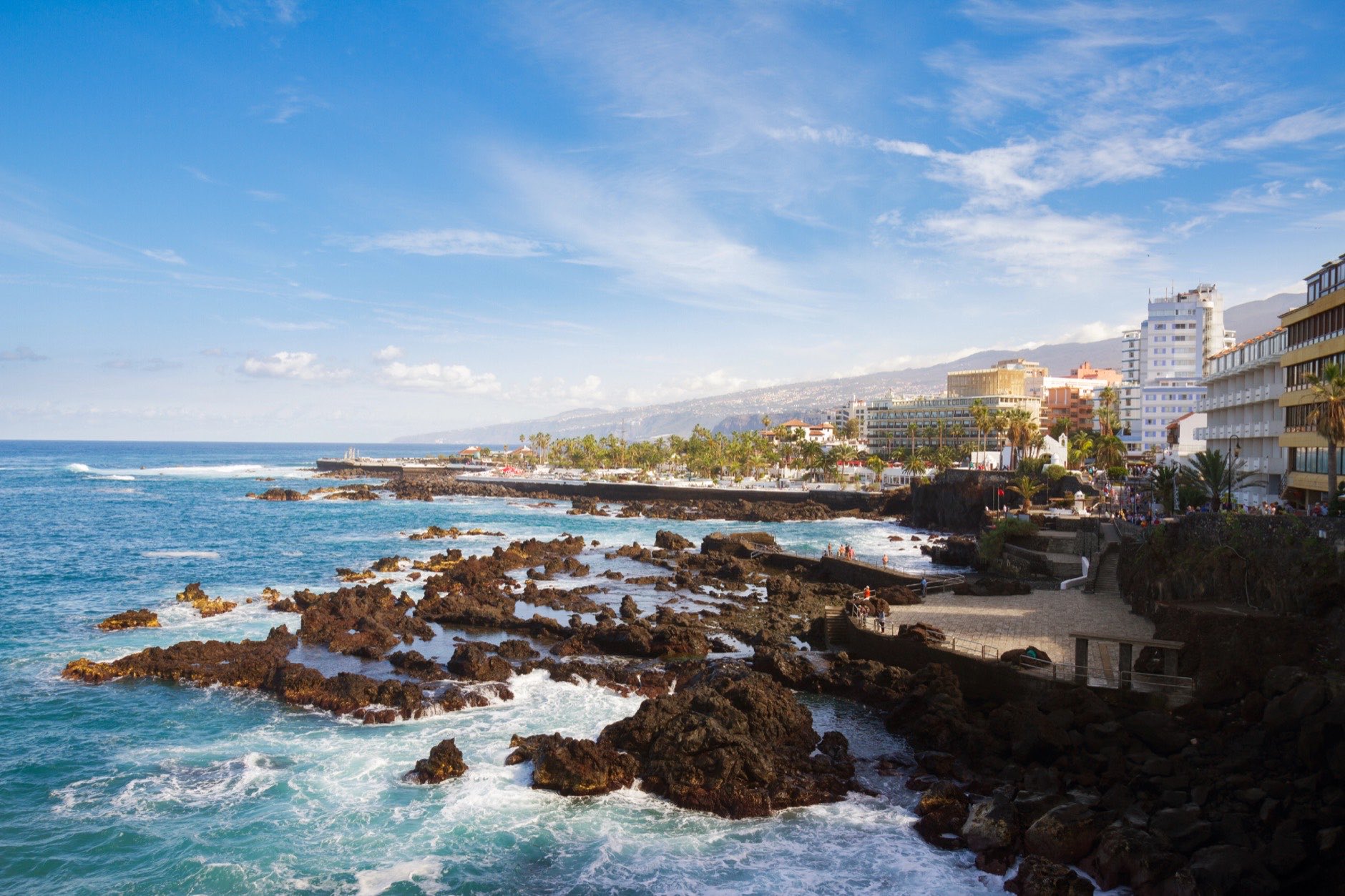
Puerto de la Cruz
Puerto de la Cruz is a town in the north of Tenerife with thirty-one thousand residents. Tourism in the Canaries started here: in eighteen eighty-six the archipelago's first sanatorium for visiting patients opened in this small port, and the town became Spain's first resort of European standing. It sits in the Orotava valley below the mountain, and that sets its weather.
The north of Tenerife is not the same as the south. Cloud off the ocean catches on the slope and hangs there: fifty-five rainy days a year and seventy-two per cent humidity in winter, against eighteen days and sixty per cent in Adeje in the south. Two hours of driving between them. In exchange the north is green, the buildings are older and denser, and housing costs less than in the south. The winter season here is a full one: from November to February the town is busy.
- La Orotava · 5 km — the old town in the valley above the port
- Teide · 50 km — the volcano and the high national park
- Santa Cruz de Tenerife · 35 km — the island capital, the port and the hospitals
Puerto de la Cruz sits in Tenerife, Canary Islands, right on the water. One of the longest swimming seasons in the database: 10 months with the sea above 20 °C. You can live here without a car: our rating is 4 out of 5, rare on the Spanish coast. The airport is 20 minutes away, closer than for most places in the database.
Hospital, terrain, getting around
Where from: the Ministry of Health hospital catalogue, road time · elevations from the Copernicus terrain model · OpenStreetMap · ratings for car-free and hospital minutes are ours.
Puerto de la Cruz sea temperature by month
10 months above 20 °CsourceAverage sea surface temperature, °C, for 2015–2024 — NOAA OISST satellite series, grid cell 8.7 km from the centre.
Tourist load
Puerto de la Cruz beaches and water quality
sourcePuerto de la Cruz has 3 beaches tested under EU bathing water rules, at 5 sampling points. In the 2025 season, 2 of 3 were graded excellent. No beach here has been graded “poor” since testing began in 1990.
The grade is bacteria in water samples over the last four seasons — not sand, views or crowds. “Poor” means bathing there is advised against.
| Beach | From the centre | Grade 2025 | “Excellent” in a row | Last “poor” |
|---|---|---|---|---|
| Playa San Telmo | 0.4 km | excellent | 1 season | none since 1990 |
| Playa Martianez | 0.8 km | excellent | 18 seasons | none since 2008 |
| Playa Jardin | 1.2 km | sufficient | — | none since 1995 |
Where from: European Environment Agency, bathing water register, seasons 1990–2025, licence CC BY 4.0. Distance is from the centre in a straight line. Every place in one table
On the map
What tenants actually pay
sourcedThis is the median rent on active leases — tax records for 2024, a sample of 2 171 leases. It includes long-standing contracts at unchanged rents, so it sits below what is asked today: our estimate of asking rent is 950 € for a two-bedroom.
The point of the 75th percentile: it is closer to what is being signed now than the median. The gap between them shows how much a new tenant overpays relative to long-standing ones.
Where from: SERPAVI, Ministerio de Vivienda · municipality: Puerto de la Cruz
Rent by number of bedrooms
asking price, estimate| 1 bedroom | 700 €/mo | |
| 2 bedrooms | 950 €/mo | |
| 3 bedrooms | ≈ 1 240 €/mo | model: two-bed × 1.3, no measurement yet |
| Median of active leases, 2024 | 580 €/mo | SERPAVI · 58 m² |
Asking prices are what long lets are advertised at today; the registry is what tenants pay on signed leases, including old ones. The gap between them is your negotiating argument.
Schools nearby
estimateInternational schools counted in the base: 1. Names and curricula for this place are not verified yet — the school registry covers the thirty most-requested places so far.
Renting without a Spanish contract
How realistic a long lease is without a nómina — on foreign income, savings or prepayment.
- —A community with its own services: agencies have dealt with foreigners before
This is our model, not a measurement: demanding a nómina is an individual landlord's practice and nobody publishes it. The rating is derived from the share of foreign residents, the presence of a community with services, price growth, seasonality of the stock and the size of the town.
Who lives here
INE 2025- Germany1 435
- Italy1 187
- United Kingdom396
- Venezuela387
- Ukraine314
- Cuba203
- Poland189
- France180
- deGerman~5 000school, doctors or lawyers in the languageGerman and British tourism here since the 1960s — the island's oldest resort community
- enEnglish~3 000school, doctors or lawyers in the language
Where from: INE, Censo Anual de Población · the register-based census counts padrón registrations by citizenship on 1 January, not everyone living here: seasonal owners and the unregistered are outside it, and naturalised residents count as Spanish.
Winter direct flights from TFN
January 2026/2720 min to the airport- Germany2
- Portugal2
- other countries2
Destinations served at least weekly in January; checked 2026-09-17.
Paperwork and practicalities
From OpenStreetMap — an open map filled in by volunteers. Something missing there may still exist: read this as «we found this many», not «there are no more».
Month by month
Air, sea, how busy it gets and what stays open — for each month on its own.
Articles that include this place
- Best time to visit Tenerife: weather, sea and the price of a hotel night, month by monthTwelve months on Tenerife from the weather service's normals, sea temperature and Spain's hotel statistics: when a hotel night costs most, when hotels empty, how the south, the capital and the north differ, and where a warm sea meets a cheaper night.
- Tenerife beaches by water quality: where the grade has never dropped, and where it slips nowGrades from the European register for every tested beach on the island since 1990: the one poor grade, the points below excellent last season, the natural pools, and the sea near our three places month by month.
- Tenerife or Gran Canaria: Tenerife grew dearer, Gran Canaria stayed fullerThe two big islands on government series: hotel prices and occupancy month by month, weather normals at the southern airports, the sea, bathing water, the census by nationality, appraised value per square metre on one basis, rent, winter flights and the drive to hospital.
- Tenerife or Fuerteventura: nearly half dearer in winter, a few per cent in summerTwo islands on government series: two years of hotel prices, weather normals, the sea, the census by nationality, appraised value per square metre, rent, winter flights and the drive to hospital. Tenerife costs more in every month, but in winter the gap is nearly half the price and in summer it almost disappears.
- Tenerife or Lanzarote: weather month by month, the price of a hotel night, neighbours, hospitals and flights homeOur seven places on the two islands from government series: which is warmer by day and by night each month, why a hotel night costs more on Tenerife in winter and on Lanzarote in summer, who the neighbours are, how far the hospital is and where January flights go.
- Retiring to coastal Spain: who already lives there, how far the hospital is, and whether the town stays open in winterThe share of residents over 65 and over 80 in every place we cover, from the INE census, the drive to the nearest public hospital, and the measured winter score. No ranking: only what the numbers show.
Where to look next
- Santa Cruz de Tenerife2 326 €/m²
- Adeje / Costa Adeje3 774 €/m²
- Yaiza2 600 €/m²
- El Puerto de Santa María2 555 €/m²
- Mataró2 512 €/m²
- Maspalomas3 100 €/m²
- Almuñécar3 021 €/m²
- Cádiz3 011 €/m²