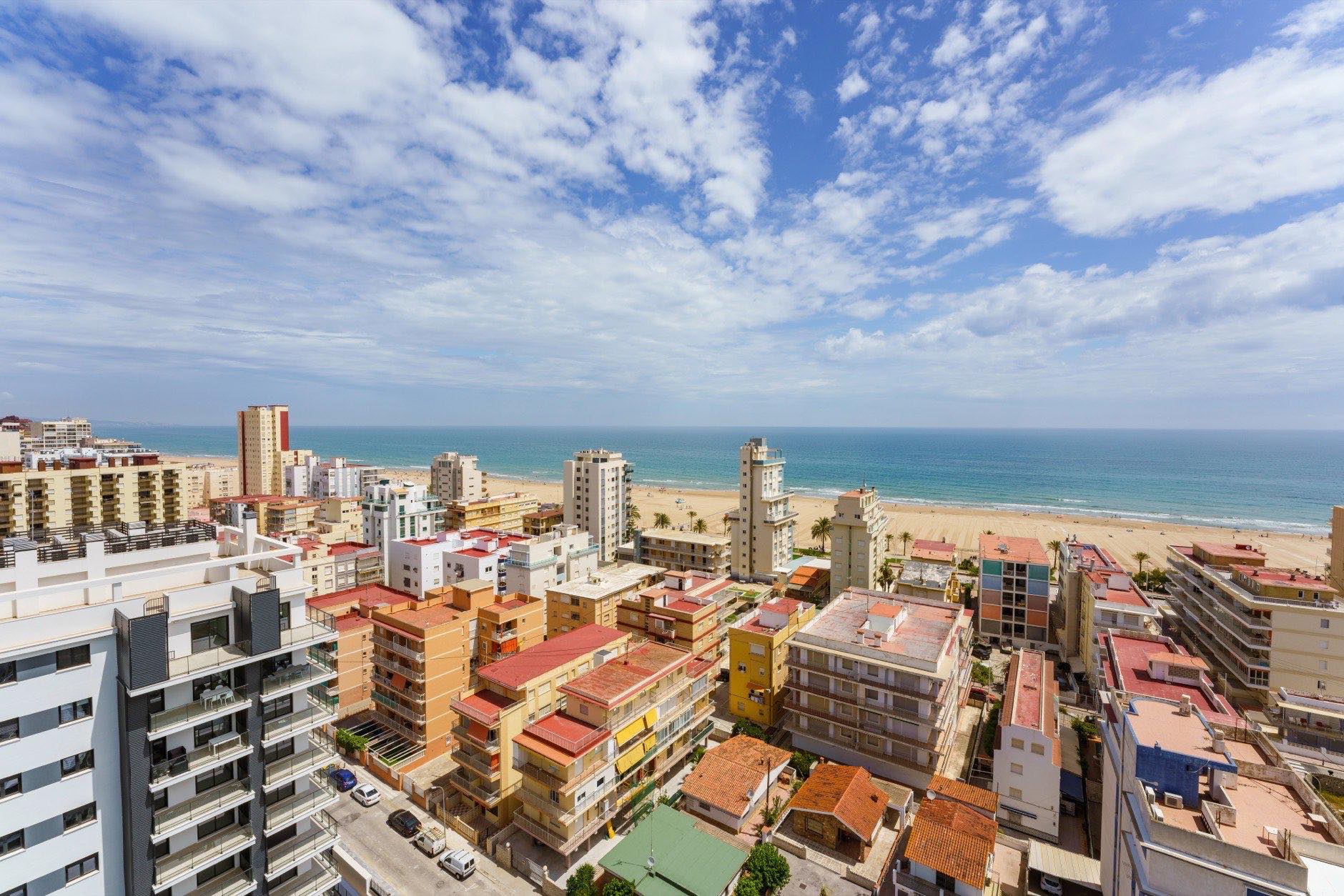
Gandia is a town in the south of Valencia province with around eighty thousand residents. It too comes in two parts. The historic centre, with the palace of the Borja dukes, sits three kilometres from the water; Gandia Platja, a resort strip with a long sandy beach, grew up separately.
The key thing for anyone moving is the train: a little over an hour to Valencia, which makes Gandia a suburb of a big city rather than a cut-off resort. In summer the coastal part fills with people from Madrid and Valencia; in winter it is quieter, but the town itself works all year — hospital, schools, market. Housing costs less than in Valencia. Around it are rice fields and orange groves, and behind them the hills that separate the coast from the interior.
Worth a trip nearby
- Valencia · 70 km — Spain's third city and its airport
- Dénia · 35 km — the port, the Balearic ferries and Montgó
- Oliva · 10 km — the beaches and dunes to the south
Resalesource
1 644€/m²
+9% price growth yoy
appraised valueappraisedValue from licensed appraisers, published by the Ministry of Housing. Not a listing price.Why it matters. It runs systematically below asking prices. Comparing it with another town's asking price flips the comparison., Ministerio de Vivienda
Populationsource
82 909
Foreign residents 26%
Sunshine hours per year
2 750h
Gandía sits in La Safor, Valencia, 3.5 km from the water. The square metre is 31% below the Costa de Valencia median: €1 644 against €2 391. You can live here without a car: our rating is 4 out of 5, rare on the Spanish coast, and the town has its own train station. 26% of residents are foreign nationals per the census: Spanish is not the only language you will hear on the street.
Hospital, terrain, getting around
Nearest hospitalsource
20min by car
Hospital Francesc de Borja de Gandía
Gandia · 5.3 km · public
Terrainsource
flat
Centre at 21 m, 7 m of elevation change
under 25 m of elevation change within 700 m — pram, bicycle, bad knees all fine
Car-freeour rating
4/5
comfortable without a car
Stations: Gandia · bus stops within 1.5 km: 17
Where from: the Ministry of Health hospital catalogue, road time · elevations from the Copernicus terrain model · OpenStreetMap · ratingswinter liveabilityOur 1-to-5 rating of whether a town lives from November to March — open places, running transport, people around.Why it matters. Most resorts shut for winter. Tourists never notice; someone who moved gets four empty months. An estimate, not a measurement. for car-free and hospital minutes are ours.
Sea temperature
5 months above 20 °CTourist load
What tenants actually pay
sourced75th percentile75th percentileThe rent that only a quarter of leases exceed. The median is the middle of all leases, old ones included.Why it matters. A new lease is signed closer to this figure than to the median: long-standing tenants pay old rates, a newcomer pays today's.
575€/mo
This is the median rent on active leases — tax records for 2024, a sample of 4 279 leases. It includes long-standing contracts at unchanged rents, so it sits below what is asked today: our estimate of asking rent is 800 € for a two-bedroom.
The point of the 75th percentile: it is closer to what is being signed now than the median. The gap between them shows how much a new tenant overpays relative to long-standing ones.
Where from: SERPAVISERPAVIThe Ministry of Housing's public registry of rents: medians of actual signed leases by municipality.Why it matters. Asking rent and signed rent are different things: across our base listings run about one and a half times above the registry. The registry shows what people actually pay., Ministerio de Vivienda · municipality: Gandia
Rent by number of bedrooms
asking price, estimate| 1 bedroom | 600 €/mo | |
| 2 bedrooms | 800 €/mo | |
| 3 bedrooms | ≈ 1 040 €/mo | model: two-bed × 1.3, no measurement yet |
| Median of active leases, 2024 | 480 €/mo | SERPAVISERPAVIThe Ministry of Housing's public registry of rents: medians of actual signed leases by municipality.Why it matters. Asking rent and signed rent are different things: across our base listings run about one and a half times above the registry. The registry shows what people actually pay. · 96 m² |
Asking prices are what long lets are advertised at today; the registry is what tenants pay on signed leases, including old ones. The gap between them is your negotiating argument.
Schools nearby
estimateInternational schools counted in the base: 1. Names and curricula for this place are not verified yet — the school registry covers the thirty most-requested places so far.
3Renting without a Spanish contract
How realistic a long lease is without a nóminanóminaA Spanish employment contract with payslips. Landlords ask for it as proof of income.Why it matters. A newcomer does not have one and will not in the first year. Where it is required, a long lease is nearly impossible — even with money in the bank. — on foreign income, savings or prepayment.
- —26% foreign residents — income from abroad is routine for landlords here
- —Prices rising 9% a year — the landlord picks, and the first filter is a nómina
This is our model, not a measurement: demanding a nóminanóminaA Spanish employment contract with payslips. Landlords ask for it as proof of income.Why it matters. A newcomer does not have one and will not in the first year. Where it is required, a long lease is nearly impossible — even with money in the bank. is an individual landlord's practice and nobody publishes it. The rating is derived from the share of foreign residents, the presence of a community with services, price growth, seasonality of the stock and the size of the town.
Who lives here
INEINESpain's National Statistics Institute. It keeps the padrón — the official register of residents of every municipality.Why it matters. The only primary source of population for the whole country. A figure 'per INE' can be checked against a table; a figure 'from the internet' cannot. 2025Foreign residents on the padrónpadrónThe municipal register of residents. Registering in it — empadronamiento — proves you live here.Why it matters. Official population comes from it, and you will need it yourself: without registration there is no health card and no school enrolment.
26%
21,521 of 82,909 · Gandia
- Colombia2 710
- Morocco2 557
- Bulgaria2 391
- Ukraine1 650
- Romania1 353
- Italy1 015
- Venezuela765
- Algeria623
Communities and services in their language
- bgBulgarian~2 500
- arArabic~2 500
- roRomanian~2 000
Where from: INEINESpain's National Statistics Institute. It keeps the padrón — the official register of residents of every municipality.Why it matters. The only primary source of population for the whole country. A figure 'per INE' can be checked against a table; a figure 'from the internet' cannot., Censo Anual de Población · the register-based census counts padrónpadrónThe municipal register of residents. Registering in it — empadronamiento — proves you live here.Why it matters. Official population comes from it, and you will need it yourself: without registration there is no health card and no school enrolment. registrations by citizenship on 1 January, not everyone living here: seasonal owners and the unregistered are outside it, and naturalised residents count as Spanish.
Winter direct flights from VLCValencia airportIATA code VLC.
January 2026/2755 min to the airport- other countries20
- Italy14
- France8
- United Kingdom7
- Germany6
- Poland5
- Netherlands4
- Ireland2
- Belgium2
- Switzerland2
- Portugal2
- Finland1
- Austria1
- Czechia1
Destinations served at least weekly in January; checked 2026-09-17.
Paperwork and practicalities
Appointment for the TIETIETarjeta de Identidad de Extranjero — the plastic residence card with your NIE and the permit's expiry. Issued at the police after entering on a visa or after a permit is approved.Why it matters. Without the card you cannot open a resident bank account, sign a long lease or prove your status at the border. The police appointment (cita) is a weeks-long bottleneck in some provinces.· Valenciafrom reports
1Since early 2025 lawyers have described the same thing: no free slots for weeks. The police opened a dedicated address, valencia.docext@policia.es, for people waiting more than two months for fingerprints. Over summer 2026 a watching service counted just 15 free slots across four stations. The only things that help are checking at eight or nine in the morning and trying the suburbs: Sagunto, Gandia, Torrent.
1 — no slots for weeks, 5 — freely available. Checked 2026-09-17
Coworking within 3 km
not on the map
Dog beaches within 8 km
not on the map
From OpenStreetMap — an open map filled in by volunteers. Something missing there may still exist: read this as «we found this many», not «there are no more».
Where to look next
Cheaper with the same sea